The manufacture of LNG-service cryogenic valves shall comply with strict process specifications. The casting surfaces shall feature uniform shot-blasted finish. All stainless-steel components shall undergo pickling and passivation. No adhering sand, welding beads, weld scars, burrs, sharp corners or other extraneous deposits are permitted inside valve cavities and flow passages. The passivation film shall be free of rust spots, stains or fuzzing.
For machined parts, grinding marks, bumps and bruises shall be avoided during machining. The surface roughness of sealing faces shall be Ra 1.6 or better. The bonnet sealing faces shall be lapped sequentially with 180-grit and 400-grit abrasive paper to achieve a surface roughness of Ra 0.4 or better. While machining, dimensional tolerances and surface roughness (Ra 1.6) of the bonnet stuffing-box bore as well as concentricity not exceeding 0.08 mm shall be guaranteed. The stem section in contact with packing shall be manufactured by cold extrusion, with surface roughness reaching Ra 0.4 or better.
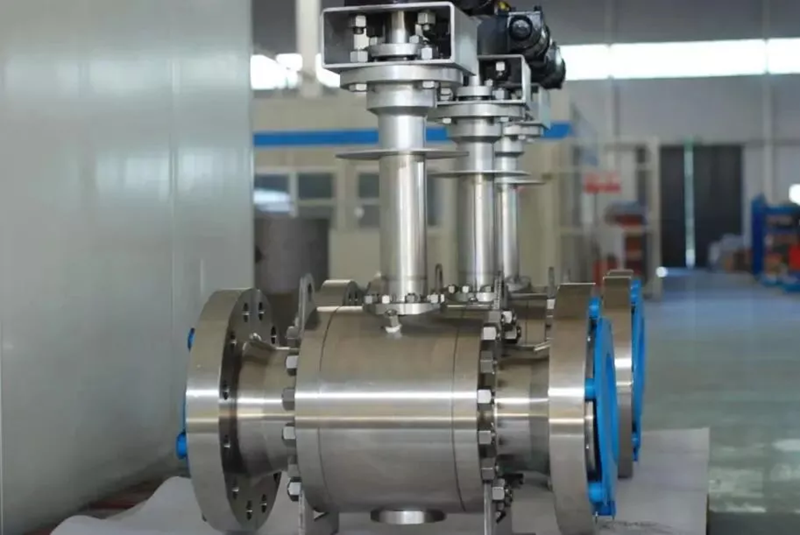
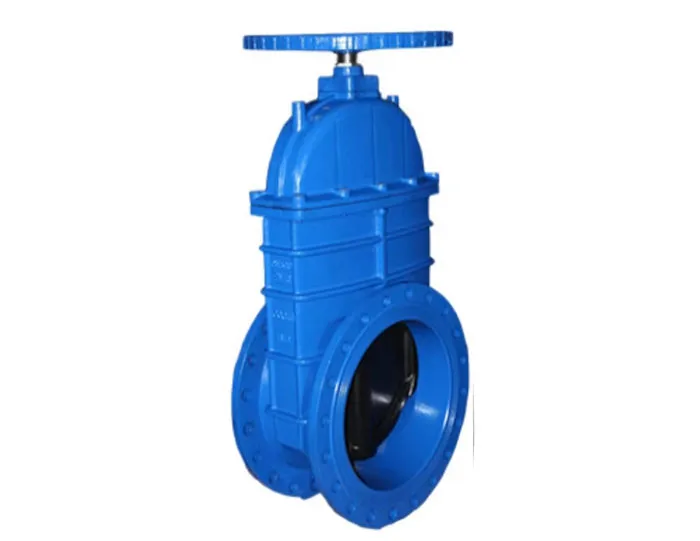
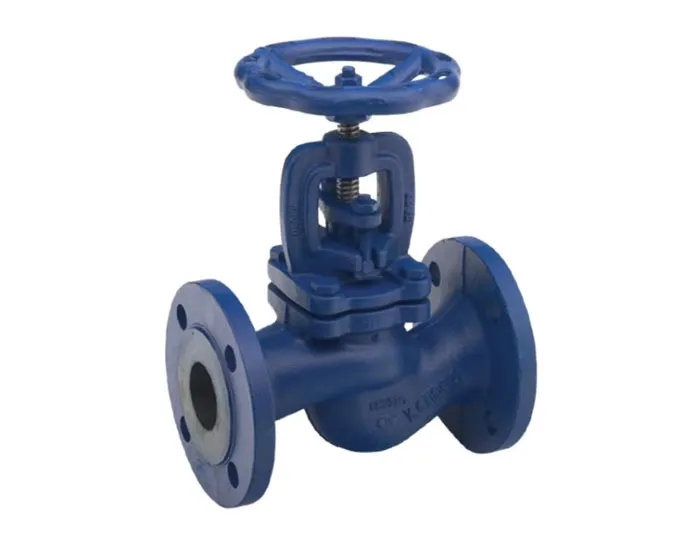
For wedge gate valves, each wedge shall be machined with a pressure-relief hole, and the 2 mm elastic-slot clearance on the wedge shall be symmetrically processed. For globe valves, the angular tolerance between seat and disc sealing faces shall be within 1°, and sealing shall take place at the lower edge of the seat sealing face against the disc. Stellite hard-facing shall be applied to both seat and disc sealing faces. Hardness difference between mating sealing faces is not mandatory; however, dye-penetrant inspection is required. Upon passing inspection, the body seat-ring sealing face shall be lapped in three successive steps: 36-grit emery paper, 180-grit abrasive paper, then 400-grit abrasive paper, yielding surface roughness of Ra 0.4 or better.
For LNG cryogenic valves designed for service temperatures below -101 °C, key components shall be subjected to cryogenic treatment prior to finish machining. Components shall be immersed in liquid nitrogen. Timing starts once liquid-nitrogen boiling ceases. The holding time shall be 2 hours for parts with maximum thickness ≤ 50 mm, and 3 hours for parts with maximum thickness > 50 mm. Cryogenic treatment minimizes deformation induced by temperature variation and metallurgical phase transformation.
Cryogenic treatment is a special process applied to core components of LNG cryogenic valves, primarily made of austenitic stainless steel. Austenitic stainless steel undergoes martensitic transformation at low temperatures. Since body-centered-cubic martensite possesses higher specific volume than face-centered-cubic austenite, volume expansion occurs at low temperature and leads to component distortion.
Temperature drop also causes metal contraction. Uneven contraction across different sections generates thermal stress. When thermal stress exceeds the yield strength, irreversible permanent deformation occurs. The objective of cryogenic treatment is to complete phase transformation and dimensional shift before finish-machining, so as to secure stable final geometry and structural integrity. Cryogenic treatment improves hardness and wear resistance, stabilizes dimensions, and enhances impact toughness of valve parts. For martensitic stainless steel, corrosion resistance is substantially improved. For non-ferrous metals, it can boost electrical conductivity and wear-corrosion resistance, reduce mould deformation and cracking, and raise dimensional accuracy.

During assembly of LNG cryogenic valves, molybdenum disulfide shall be applied to the middle-flange bolts, swing bolts, gland thread fits and nut back faces; excess external coating shall be thoroughly removed. Silicone grease shall be applied to stem-nut threads and bosses. No lubricants shall be introduced into internal cavities or sealing faces. Scratches, bumps and bruises shall be prevented throughout assembly and testing. Tightening torques shall follow specified values. Routine tests shall be performed in accordance with API 598, including low-pressure and high-pressure tests using 100 % nitrogen as test medium.
After passing pressure tests, complete valves shall be ultrasonically cleaned and disassembled. Disassembled components shall be neatly laid out. Sealing faces shall receive secondary lapping until a mirror-like finish of Ra 0.2 or finer is achieved, free of any abrasive-paper traces. Components of ultra-low-temperature valves must be dry and degreased. Degreasing shall be carried out using the SGT28-7200 ultrasonic cleaner with INT-100 high-efficiency water-based metal detergent at a concentration of 5-6 % and water temperature maintained at 60-70 °C. For stainless-steel valves, chloride-ion content in test water shall be kept below 30 ppm.
Subsequently, valve bodies and other components shall be cleaned and blown dry with clean compressed air. Hot-air guns shall dry gaps between seat rings and valve bodies. Cleaned valve bodies shall rest on pallets covered with clean paper and be wrapped in plastic bags. Final assembly shall commence only after all foregoing procedures are completed.
Cryogenic valves play a vital role in the LNG industry. With continuous expansion of the LNG sector, performance requirements for cryogenic valves keep rising. In future, cryogenic valves will develop toward intelligence, higher performance and energy conservation, providing more reliable guarantees for safe, stable and efficient operation of LNG facilities. Meanwhile, intensified R&D and innovation shall elevate domestic technical capabilities and competitiveness in cryogenic-valve manufacturing, contributing to China’s energy-structure transition and sustainable economic development.